Historical Background
The Simatai Great Wall stands as one of the most historically significant and visually breathtaking sections of China’s ancient frontier fortifications. Located in Miyun District, approximately 120 kilometers northeast of Beijing, this formidable structure was originally constructed during the early Ming Dynasty (1368–1644), with its foundational walls laid between 1368 and 1398. However, the section visitors marvel at today owes its distinctive character to a comprehensive reconstruction undertaken during the reign of the Wanli Emperor (1573–1620), under the brilliant military leadership of General Qi Jiguang. Tasked with reinforcing the northern border against Mongol incursions, Qi Jiguang transformed the Simatai Great Wall into an impenetrable line of defense, integrating natural cliff faces into the wall’s design so ingeniously that man-made and natural fortifications become one seamless barrier.
What sets the Simatai Great Wall apart in the broader history of the Great Wall is its remarkable state of preservation. Unlike more heavily restored sections such as Badaling or Mutianyu, the Simatai Great Wall retains its original Ming Dynasty appearance—weathered gray bricks, crumbling watchtowers, and all. This authenticity offers visitors an unvarnished glimpse into the engineering challenges of the past, where laborers hauled enormous granite blocks and kiln-fired bricks up sheer mountain slopes. The wall snakes for roughly 5.4 kilometers along the rugged Yanshan Mountains, punctuated by 35 beacon towers, each strategically placed to relay smoke signals. Because of its demanding terrain and the immense labor required for its construction, the Simatai Great Wall became legendary even in its own time, a testament to the Ming Dynasty’s relentless commitment to safeguarding its capital.
Architectural Features
The architectural ingenuity of the Simatai Great Wall is nothing short of extraordinary, particularly given the extreme topography it navigates. The wall climbs and plunges with breathtaking intensity, at points ascending nearly vertical cliff faces at gradients approaching 85 to 90 degrees. Its most famous architectural highlight is the “Heavenly Ladder” (Tian Ti), a spine-tingling stone staircase carved into the bedrock that rises at a near-vertical pitch for over 100 meters. Above this ladder perches the “Fairy Tower” (Xiannu Lou), a compact watchtower set upon a seemingly unreachable summit, accessible only by the most intrepid climbers. Another jewel is the “Mirror Tower” (Wangjing Lou), standing at the highest elevation of the section at approximately 986 meters, offering panoramic vistas that stretch for dozens of kilometers across the wild, forested mountains of Hebei and Beijing.
One of the most distinctive construction details at Simatai is its double-sided crenellation—both the inner and outer parapets feature battlements, a rarity among Great Wall sections, where typically only the outward-facing side was fortified with tooth-like merlons. This dual-wall design suggests Simatai functioned not merely as a defensive bulwark but also as a fully self-sufficient garrison line, capable of repelling attacks from either direction. The watchtowers themselves vary dramatically in design; some are two-story structures with vaulted interiors and arrow slit windows, while others are compact single-room outposts. Below the wall’s surface, the foundations are laid with enormous, rough-hewn granite blocks fitted together without mortar, a technique that allowed the wall to withstand centuries of seismic activity and torrential rain. The brickwork above, laid with a lime-based mortar, demonstrates the Ming Dynasty’s sophisticated construction methods, which created a structure durable enough to survive more than 400 years of exposure to the elements.
Strategic Significance
The strategic importance of the Simatai Great Wall cannot be overstated within the context of Ming Dynasty military geography. The wall’s position was chosen to guard the Gubeikou Pass, one of the most critical gateways through the Yanshan Mountains leading directly toward Beijing. Throughout the Ming era, the northern grasslands were home to powerful Mongol confederations, and Gubeikou had historically served as a primary invasion route. The Simatai Great Wall, therefore, served as the final formidable barrier before an invading army could reach the North China Plain and threaten the imperial capital. Its relentless elevation changes were no accident—by aligning the wall with the most precipitous ridges, the Ming engineers ensured that besieging forces would have to contend with both the wall itself and the cruel, jagged terrain upon which it stood.
Beyond its physical defense, the Simatai Great Wall functioned as a sophisticated early-warning and communication hub. The 35 beacon towers along its length were part of an integrated network that extended all the way to Beijing’s Forbidden City. Using a coded system of smoke signals during the day and beacon fires at night, defenders could transmit the approach of a large army to the capital in a matter of hours, dramatically increasing the empire’s reaction time. The wall also patrolled and controlled trade routes, regulating the movement of merchants and goods between the steppe and the agricultural heartland. This dual military and economic function made Simatai a cornerstone of the Great Wall’s broader strategic system, and its location ensured that the section remained a robust military garrison throughout the dynasty, staffed by soldiers who lived in the towers and farmed fortified settlements below the wall.
Notable Events & Legends
The dramatic cliffs and remote towers of the Simatai Great Wall have inspired a rich tapestry of legends. The most enduring story is that of the Fairy Tower, which tells of a beautiful maiden who descended from the heavens to live atop the isolated peak where the tower now stands. According to local lore, she watched over the soldiers stationed below, using her celestial power to calm the turbulent mountain weather and guide lost travelers through the steep passes. When she finally returned to the heavens, the tower she called home remained as a guardian monument—hence its name. Another legend recounts that the construction of this tower was so perilous that the master craftsman who completed it was rewarded with an imperial title, an astonishing honor in a society where builders were typically unsung laborers.
Historical events, too, have left their mark on this rugged landscape. During the late Ming Dynasty, the wall’s garrison saw action during periods of Mongol raiding, and in the 1930s and 1940s, the Simatai region was the site of skirmishes during the Sino-Japanese War, as the wall’s fortifications became improvised defensive positions. Locals also tell of a tragic romance during the late Qing Dynasty, when a young soldier stationed at the Mirror Tower fell in love with a village girl from the plains below; their story of impossible love across the mountains has become a poignant emblem of the wall’s lonely garrison life. While the details of these legends are largely unverifiable, they add a layer of human warmth to the stark, monumental beauty of the stones.
What to See Today
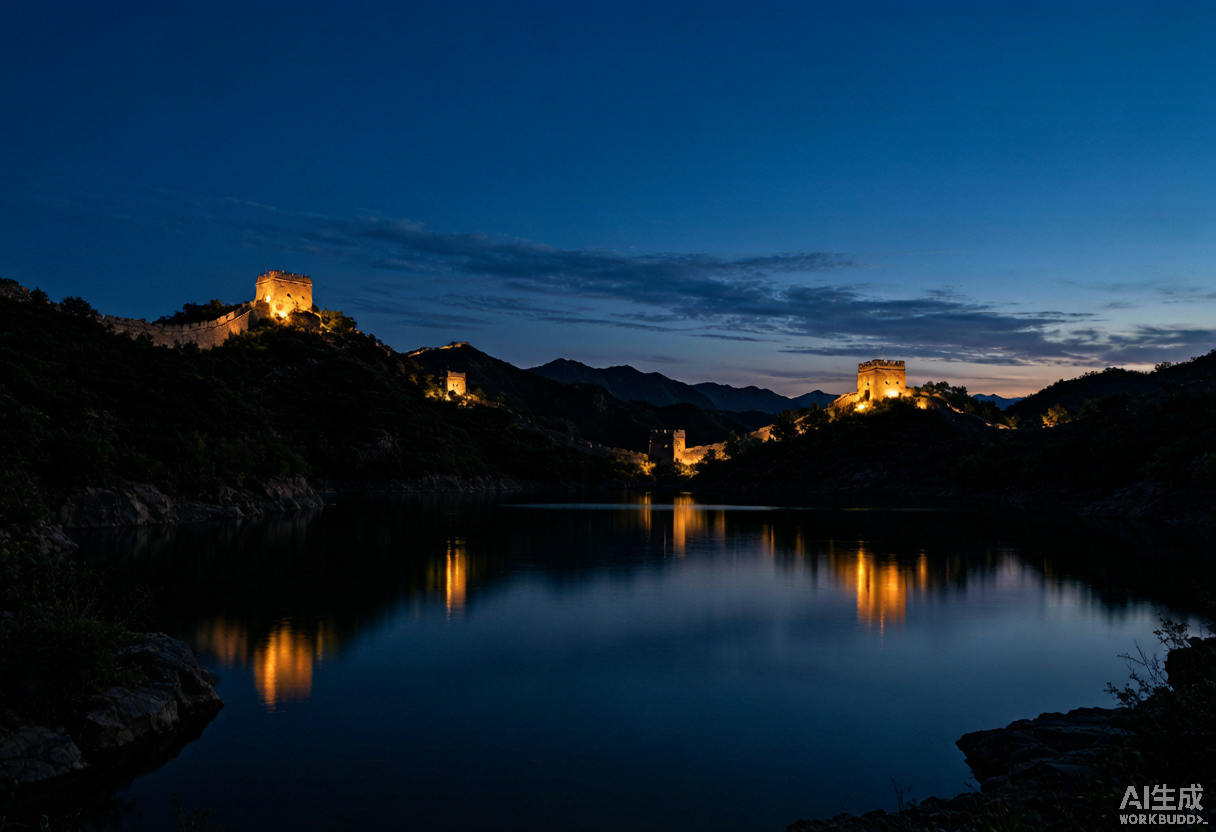
Today, the Simatai Great Wall offers one of the most exhilarating and authentic Great Wall experiences in China. The entire section is divided into several zones, with the western portion accessible via a modern cable car that eases visitors toward the key watchtowers, while the eastern portion—with its infamous Heavenly Ladder and Fairy Tower—remains a challenging climb that rewards the determined with unrivaled views. The contrast between the wild, unrestored eastern wall and the carefully maintained western ramparts provides a fascinating before-and-after insight into Ming construction. At the wall’s base lies the serene Mandarin Duck Lake (also known as Tai Chi Lake), a tranquil reservoir that reflects the steep ridge on its shimmering surface, creating one of the most photographed vantage points in the area.
The Simatai Great Wall is also unique for its pioneering night tours, during which the watchtowers and wall sections are illuminated with subtle, warm lighting. Walking the wall under a canopy of stars, with the silhouettes of crenellations and towers glowing against the mountain darkness, is an unforgettable experience that few other Great Wall sites offer. Adjacent to the wall lies Gubei Water Town, a picturesque riverside development built in the style of a traditional northern Chinese water village, complete with arched stone bridges, lantern-lit alleys, and artisan workshops. This combination of rugged ancient fortifications and romanticized water-town scenery makes Simatai a complete day-and-evening destination, ideal for photographers, hikers, and history enthusiasts alike.
Visiting Tips
To make the most of a visit to the Simatai Great Wall, careful preparation is essential. The climb is genuinely strenuous, with steep stone steps and exposed cliff-edge paths; visitors should wear sturdy, non-slip hiking shoes, carry ample water, and be prepared for significant elevation gain. The optimal seasons are autumn (September to November), when the surrounding foliage bursts into crimson and gold, and spring (April to May), when the mountains bloom with wildflowers. Summer can be oppressively hot, and winter brings biting winds and icy steps, making winter visits challenging but spectacularly atmospheric. For those who want the full experience without exhaustive physical exertion, taking the cable car to the western section allows easier access to several towers, while the physically fit should plan at least three to four hours to tackle the eastern loop.
When planning logistics, note that the Simatai Great Wall is approximately a two-and-a-half to three-hour drive from central Beijing, with direct buses and tours available; many visitors wisely combine a visit with an overnight stay at Gubei Water Town to catch both sunset and the illuminated night tour. Arrive early in the morning to beat tour groups and experience the wall in relative solitude, or plan for a late-afternoon arrival to witness the legendary golden-hour light that paints the ramparts a deep amber hue. It is also worth booking night-tour tickets in advance during peak seasons, as access is limited. Finally, respect the fragile nature of the site—this is a 400-year-old treasure in its original state, so stay on marked paths, avoid climbing on unstable parapets, and take nothing but photographs. The Simatai Great Wall is not merely a sightseeing attraction; it is a living monument to the endurance of human ambition, and a visit here is a profound encounter with Chinese history.