The Setting
In the thin, cold air of early October 1935, a column of ragged soldiers crested the rocky ridgeline of Liupan Mountain, a rugged spur of the Qinling range straddling the border between Ningxia and Gansu provinces. They had been walking for nearly a year. The men wore straw sandals and faded uniforms, their rifles slung over shoulders held together by hope more often than leather. Behind them lay the impossible arithmetic of the Long March—some 86,000 men had departed Jiangxi a year earlier; fewer than 7,000 remained. Ahead lay the plains of Shaanxi, where a small communist enclave in Yan’an promised the first real sanctuary the movement had known since Chiang Kai-shek’s encirclement campaigns had driven them from their southern bases.
Among them walked a forty-two-year-old commander with a poem in his head and a paradox in his heart. Mao Zedong, the chairman of the Chinese Communist Party, was at his most ceaselessly creative and politically vulnerable. In January 1935, at the Zunyi Conference, he had seized military leadership from his rivals in the Soviet-trained faction, but his authority was still fragile, contested by men who believed his guerrilla instincts were outdated. The march had been a crucible of exhaustion, betrayal, and narrow escapes—the crossing of the Dadu River, the frozen ascent of Jiajin Mountain, the grasslands where men drowned in hidden bogs. Yet here, at the summit of Liupan, with the yellow earth of the northern loess plateau unrolling beneath a pale autumn sky, Mao felt something rare: the sensation of clarity. That evening, in a cave dwelling near the mountain’s base, he composed a lyric poem in the ancient ci form. Its final couplet would outlast every battlefield, every policy, every monument built in his honor. “不到长城非好汉” — “He who has not reached the Great Wall is not a true man.” This single phrase became the foundation of what historians now call mao’s quote and the politics of the wall.
The Story
The poem, titled “Qingpingyue: Liupan Mountain,” was as much a political manifesto as a landscape sketch. It opened with images of the sky’s wild geese and the mountain’s roiling clouds, but its true subject was human will. The famous line was never about tourism. In 1935, the Great Wall was not a scenic destination—it was a broken chain of earthworks, largely occluded by brush and neglect, symbolizing an imperial past that revolutionaries had sworn to demolish. Yet Mao reached for it deliberately, transforming the wall from a relic of feudal order into a metaphor for revolutionary endurance. To “reach the Great Wall” meant to survive, to endure, to arrive at the destination that history had appointed. To fail was to be unworthy of the name “good man”—a phrase that, in the Confucian tradition, carried moral, martial, and masculine weight. Mao, who had been schooled in classical poetry and had a profound attachment to the folk idioms of his native Hunan, was consciously rebooting the wall’s symbolism for a generation that had been taught to despise it.
The line was also a quiet rejoinder to his political enemies within the Party. By framing the march’s completion as the ultimate test of manhood, Mao was making a claim: those who had wavered, who had criticized his leadership, who had proposed dissolving the Red Army into scattered guerrilla bands, were not merely wrong—they were unworthy. The wall, in Mao’s hands, became a gatekeeper of revolutionary legitimacy. It was a subtle but devastating political argument, delivered in the guise of a nature poem. He read the finished lyric to his companions that night, including a young bodyguard who would later recall the intensity of Mao’s recitation, his voice cracking with emotion as he described the clouds and the high, thin sky. The poem was not published until 1948, thirteen years later, appearing in a compilation of Mao’s wartime verses printed in the liberated zones. By that time, the civil war was approaching its end, and the line took on a new, electoral significance: the Party that would soon govern all of China had reached the wall and beyond.
The People Behind It
The immediate audience for Mao’s poem was a cast of extraordinary survivors. There was Zhou Enlai, his chief diplomat, still suffering from a liver infection that had nearly killed him during the march. There was Zhu De, the beloved commander-in-chief, a man of colossal humility who had led the rear guard through the worst of the grasslands. There was Peng Dehuai, the brooding field commander from Hunan, whom Mao would reward in the poem’s original draft with a separate couplet praising his cavalry maneuvers. And there were the ordinary soldiers—the porters who carried radio batteries on their backs, the teenage nurses who walked with opium poppies sewn into their collars as emergency anesthetic, the local guides from the Hui Muslim villages of Ningxia who led the column through the mountain passes. Mao’s poem, for them, was not a text but a promise: the destination justified all sacrifices. That promise would be tested brutally in the decades to come, yet the emotional contract it created was real and durable.
Behind the soldiers stood a yet deeper cast: the millions of Chinese who never marched but who would inherit the poem’s vocabulary. The phrase “good man” deliberately invoked the folk morality of the countryside, where a man’s worth was proven by his ability to complete a journey, to reach the wall, to stand at the edge of the known world. In this sense, Mao’s poem was a translation—he took the Confucian scholar’s admiration for the wall, the peasant’s awe at its scale, and the revolutionary’s need for a cleansing symbol, and fused them into eight characters. The people behind the quote were therefore not merely the Red Army but the entire stock of China’s popular imagination, which had long associated the wall with frontiers, exile, and heroic suffering. Mao’s genius was to look at that tradition and invert it: the wall was no longer a boundary that excluded the barbarian, but a threshold that admitted the brave.
What Happened Next
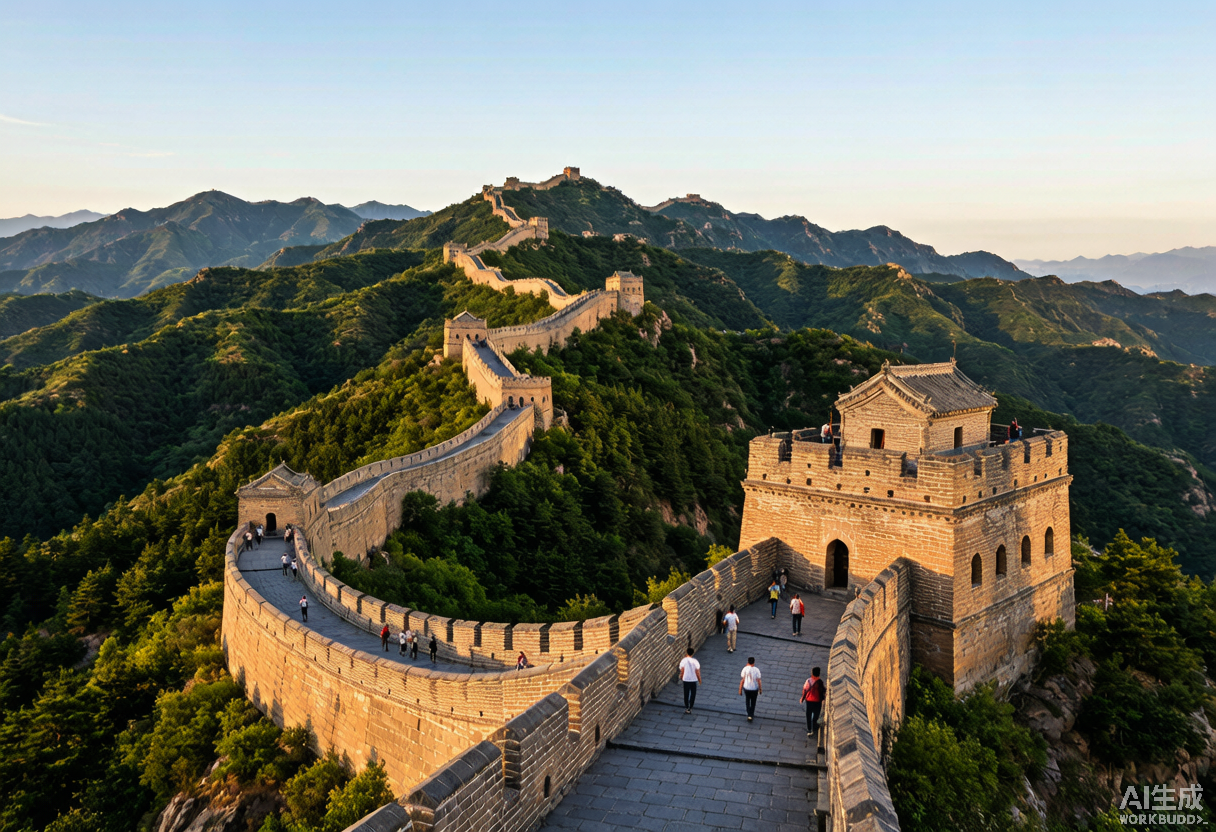
After the founding of the People’s Republic in 1949, the quote exploded beyond the poem. In 1952, the government began restoring sections of the wall at Badaling, the pass near Beijing, in part to receive foreign dignitaries. By the mid-1950s, Mao’s line was inscribed on a stone tablet at the summit of Badaling’s watchtower, where it has remained ever since, worn smooth by a million fingertips. The phrase became a standard in school readers, a headline in Liberation Army Daily articles, and a slogan for infrastructure campaigns—when the state built railways, reservoirs, and factories, it routinely declared that the “Great Wall” of socialism was being constructed, and that those who finished the task were true men. The politics of the wall, once a revolutionary argument, had become a governance tool.
The quote’s most consequential afterlife, however, was in foreign policy. In 1972, when President Richard Nixon visited China, the American delegation was taken to Badaling and photographed standing before the same inscription. For Nixon, the wall was a geopolitical spectacle; for Mao, it was a stage prop in a carefully choreographed performance of China’s reentry into world politics. The image of the American president, the archetypal Cold War adversary, smiling beneath the words “He who has not reached the Great Wall is not a true man” signified, in Mao’s calculation, that the United States had now acknowledged China’s centrality. The phrase became a shorthand for diplomatic recognition itself: to visit the wall was to acknowledge Chinese power. The quote also traveled domestically. During the Cultural Revolution, Red Guards painted it on trains, banners, and the walls of schools, using it to shame intellectuals who hesitated to join mass campaigns. Its flexibility was its strength: it could mean perseverance, patriotism, militarism, or tourism, depending on the decade and the speaker.
Why It Still Matters
Today, mao’s quote and the politics of the wall remains one of the most reproduced inscriptions on Earth. It is printed on T-shirts, carved into jade pendants, and broadcast in airport advertisements. More than 10 million Chinese tourists climb the wall annually, and a remarkable proportion of them—surveys suggest nearly three-quarters—cite the desire to “prove themselves” as the primary motivation, a direct inheritance of Mao’s eight characters. The phrase has become a rite of passage, a pilgrimage vow, and a self-help mantra, stripped of its revolutionary context but retaining its emotional charge. For the modern Chinese state, the quote is a vector of soft power: it converts a tourist experience into a civic virtue, aligning individual achievement with national identity.
But the deeper matter is what the quote reveals about how walls function in political life. Mao understood that a wall is never only architecture—it is an argument about who belongs and who does not, who has the right to pass and who must remain outside. His use of the Great Wall as a metaphor for revolutionary discipline was a stroke of genius precisely because it hid the coercive edge of that argument in a poetic image. When we stand at Badaling today, we are not standing at a frontier of the ancient past; we are standing at the intersection of a thousand years of imperial symbolism and a century of revolutionary politics. The stone beneath our feet has been stepped on by Ming dynasty sentries, Republican-era hikers, Mao’s soldiers in the civil war imagination, Nixon’s entourage in 1972, and millions of tourists since. Each group read the wall differently, but all of them were performing an act of legitimation. To understand mao’s quote and the politics of the wall is to understand how a phrase can become a monument, and how a monument can become a political argument that never closes. The quote endures not because it is true, but because it is useful—to poets and presidents, to pilgrims and premiers—and that utility, refined over ninety years, is one of the most durable structures the Chinese state has ever built.