The Setting
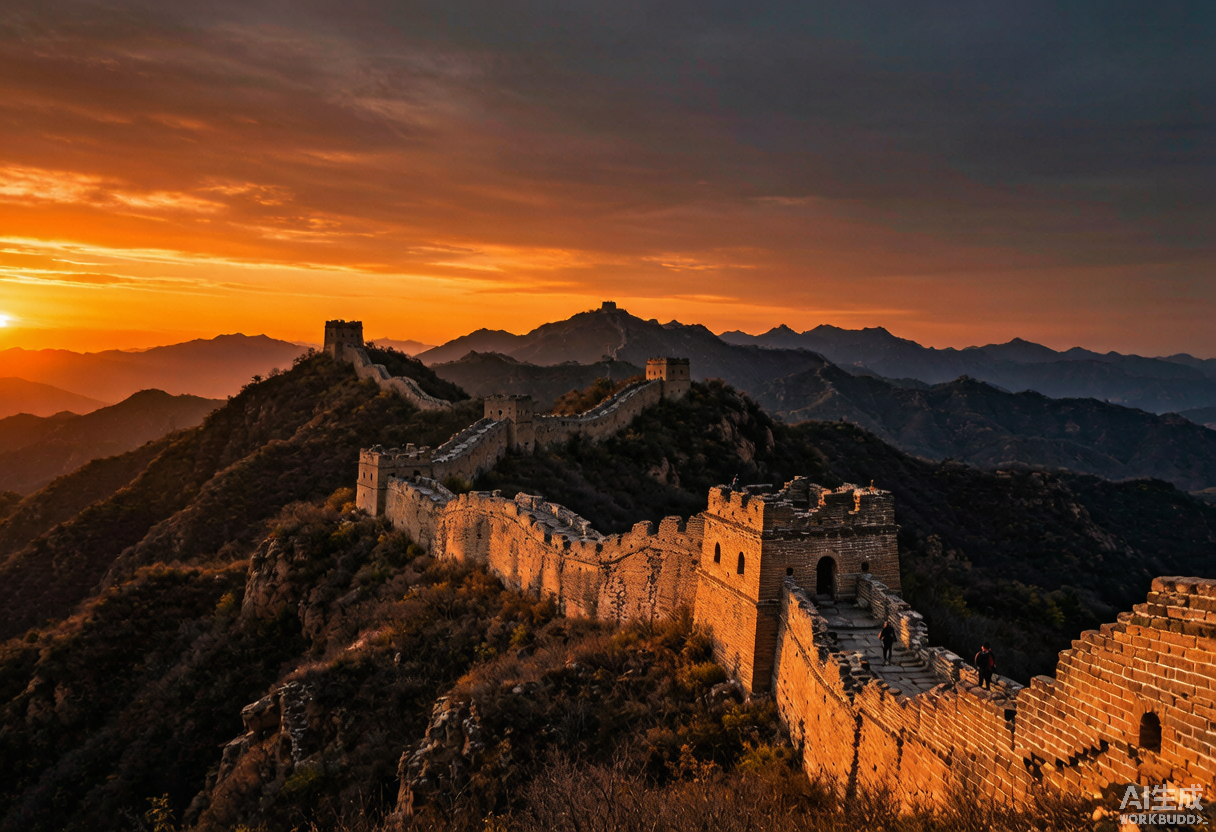
Dawn breaks over Jiankou, the most infamous stretch of the Great Wall in all of China. Here, some fifty kilometers north of Beijing, the Wall has been abandoned to the mountains. It claws upward at angles that would defeat a modern hiker, its crenellations eroded into fangs, its bricks loosened by eight hundred winters of frost and wind. This is the Great Wall as you have never seen it in a postcard. There are no cable cars, no handrails, no souvenir vendors. What remains is what the Ming dynasty risked everything to build and what nature has been patiently reclaiming ever since.
Nowhere on earth does the question of how to treat a monument become more urgent than in this place. To look at Jiankou is to see the central tension of heritage work made physical: should we freeze time, rebuilding what has fallen? Or should we let time have its way, preserving the honesty of decay? This is the heart of the restoration vs. preservation the great wall debate, a quarrel that has simmered in China for over a century and now draws travelers, archaeologists, and engineers from every corner of the world to argue about a structure that is itself nothing less than a geology of human ambition.
The Story
The argument did not begin in the modern era. It began the moment the first brick was set atop the first rammed-earth wall during the Warring States period, around the fifth century BCE. When the first Qin Emperor, Qin Shi Huang, ordered the scattered kingdoms’ defenses joined into one continuous line in 221 BCE, his engineers did not build over the older walls; they demolished and rebuilt entire sections, recycling ancient stone with the same ruthless pragmatism he applied to conquered enemies. Every dynasty that followed—the Han, the Northern Wei, the Sui, the Jin—rewrote the Wall to fit its own fears and technologies. The Ming dynasty between 1368 and 1644 performed perhaps the most radical “restoration” in history: they overlaid hundreds of kilometers of earlier rammed-earth fortifications with their signature brick-and-lime masonry, changing the Wall’s very color, chemistry, and silhouette for all time.
So when modern conservationists began their campaigns in the twentieth century, they faced a fundamental irony: the Wall they wanted to save was itself a palimpsest of ambitious restorations. In 1908, the American explorer William Edgar Geil became the first foreigner to traverse the Wall’s entire length, and his celebrated photographs showed crumbling watchtowers already half-collapsed into the landscape. By the 1950s, those collapsed sections had become building suppliers. Villagers carted away Ming-era bricks to construct homes, pigsties, and roads, a practice so widespread that entire stretches of the Wall vanished within a generation. The turn against this destruction came dramatically in 1984, when the calligrapher and statesman Deng Xiaoping wrote the words “Love our China, restore our Great Wall” onto a banner that launched a nationwide fundraising campaign. Money poured in from overseas Chinese communities, schoolchildren, and even factory workers, and restoration crews swarmed sites like Badaling and Mutianyu where entire crumbling bastions were dismantled, replaced with new bricks fired in the old kilns, and reassembled to their presumed former glory.
The ambition was noble, but the method produced horrifying results. In many restored sections, workers replaced original Ming bricks with commercially fired substitutes that were too glossy, too regular, and a shade of gray that had never existed in the sixteenth century. Concrete was poured into the core of ancient walls, forever altering their structural integrity. At scenic spots like Badaling, the Wall became a theme park where visitors strolled along neat Disneyfied ramparts, and critics began to whisper that what we called “restoration” was actually fabrication. The debate now had a name and a face, and that face was the famous “Wild Wall”—the miles of unrestored, beloved, dangerously beautiful Jiankou and its sister sections that still clung to the cliffs exactly as the Ming left them.
The People Behind It
At the center of this storm stood Luo Zhewen, the man many called “the father of Great Wall protection.” A protégé of the legendary historian Liang Sicheng, Luo spent six decades walking the Wall and mapping its condition, and his 1983 paper “A Discussion of the Great Wall in History” established the fragile distinction between preserving the Wall’s spirit and preserving its substance. Luo argued, controversially, that an honest ruin was more valuable than a synthetic reconstruction—that a Mongolian pony treading a Ming-era flagstone was a more profound encounter with history than a tourist repeating the same walk on a neat new pavement. He lobbied to classify the Wall as a UNESCO World Heritage site, a status granted in 1987, but he also warned that UNESCO’s blessing would bring millions of visitors whose very footprints would accelerate decay. His solution was radical: leave sections like Jiankou alone, permit only emergency stabilization, and treat the Wall as a beautiful corpse to be respected with eyes, not hammers.
Opposite Luo’s camp rose a generation of engineers and tourism officials who insisted that the Wall’s purpose had always been to stand. Among them was Dong Yaohui, a soldier-turned-writer who in 1984 walked the entire length of the Wall with two companions—a journey of 508 days and over seven thousand kilometers that exhausted his shoes and transformed his life. Dong declared that a Wall crumbling back into earth was a Wall that “lost the war a second time.” He pushed for the massive restorations of the 1990s, especially the reconstruction of the Simatai section, which used original methods of lime mortar and brick-making but could not resist the temptation to fill holes with modern materials. The tension between Luo’s preservation and Dong’s restoration became a personal and philosophical duel, fought not with fists but with scholarly papers, television documentaries, and funding decisions that determined the fate of every stretch of undecided Wall.
What Happened Next
The early twenty-first century forced a reckoning. In 2003, a disastrous collapse at the Jinshanling section—caused by heavy rains percolating into concrete-repaired gaps—killed two workers and revealed how badly modern materials could undermine ancient structures. An investigation by the State Administration of Cultural Heritage found that several “restored” sections were in worse structural condition than some untouched ones. The scandal effectively ended the naive era of full reconstruction. In 2006, China’s State Council issued the Regulations on the Protection of the Great Wall, which explicitly prohibited “any activity that damages the authenticity or integrity of the Great Wall” and required that all repairs use traditional materials and techniques. For the first time, “minimum intervention” became law.
The new principle was tested at Jiankou in 2016, when a violent storm breached the wall and created a spectacular sixty-meter gash. The debate roared back to life, but this time the response was telling. Workers—most of them descendants of the very families who had once stolen bricks for their homes—returned those bricks to their original locations. They repointed joints with lime mortar made exactly as the Ming had made it, and they did not reconstruct the watchtowers that had collapsed a century ago; they simply stabilized the surviving stones so no further material would be lost. For the first time in the modern era, restoration and preservation made their peace: the Wall was made safe but not pretty, intact but not invented. This compromise, half-heartedly blessed by both Luo’s and Dong’s descendants, became the model for every subsequent project from Badaling to Jiayuguan.
Why It Still Matters
Standing on a quiet section of the Wall today—perhaps the crumbling, wild stretch at Jiankou—you can personally experience why this restoration vs. preservation the great wall debate is not academic trivia. The debate touches on the deepest questions any civilization can ask itself: Do we preserve monuments for the sake of future generations, or for the sake of their original builders? Are we custodians of authenticity, or storytellers who reshape the past to fit our present needs? When a brick crumbles at Jiankou, it is not merely stone falling to earth; it is the final choice made manifest between two philosophies that can never be perfectly reconciled. The Wall was never a single structure—it was always a conversation across centuries, rebuilt and reimagined by every hand that touched it.
Today, the Great Wall spans over twenty-one thousand kilometers, and fewer than one-fifth of those kilometers remain visibly intact. The rest have returned to the mountains like breath returning to mist. Maybe that is not failure. Maybe the crumbling ruins speak more truthfully about time than any perfect rampart ever could. When you stand at Jiankou and see the Wall vanish into the ridgeline ahead, receding like a stream into fog, you understand that the only true preservation is the preservation of this very tension. The debate over how to treat the Wall will never be settled, and that is precisely why the Wall remains a living monument. Because a question that persists, a dialogue that never ends, is the most honest memorial we can build for a structure that was always, finally, an argument in stone.