Historical Background
The Mutianyu Great Wall stands as one of the most magnificent and best-preserved sections of the entire 5,000-mile fortification system, yet it holds a unique distinction among its more famous counterparts. While Badaling receives the lion’s share of tourist attention, historians and seasoned travelers alike argue that the Mutianyu Great Wall offers a far more authentic and immersive encounter with Ming Dynasty military engineering. Its origins trace back to the mid-14th century, when the first Ming emperor, Zhu Yuanzhang (Hongwu Emperor), ordered the construction of a new, consolidated line of defense immediately after driving the Mongols back into the steppe. In 1368, General Xu Da, one of the founding heroes of the Ming Dynasty, initiated the construction of the walls and passes in the mountainous terrain north of the imperial capital, and the site at Mutianyu was chosen for its commanding position along the northern ridge of the Yanshan mountain range.
However, the Mutianyu Great Wall as it appears today is largely the product of a later, far more ambitious renovation project. During the mid-16th century, the Ming Dynasty faced renewed and severe threats from Mongol confederations led by chieftains like Altan Khan, whose cavalry repeatedly raided the northern frontier, even threatening Beijing itself. In response, the imperial court appointed the celebrated general Qi Jiguang as Commander-in-Chief of the Jizhen (the military district guarding the capital) in 1567. Over the following decades, Qi Jiguang supervised an extraordinary overhaul of the wall system, transforming rough earthen and stone barriers into a sophisticated, heavily fortified military installation. This comprehensive rebuilding program, which lasted from 1569 into the 1580s, is the reason the Mutianyu Great Wall possesses its remarkably intact battlements, watchtowers, and patrol pathways—many of which survive to this day nearly exactly as they were constructed.
Architectural Features
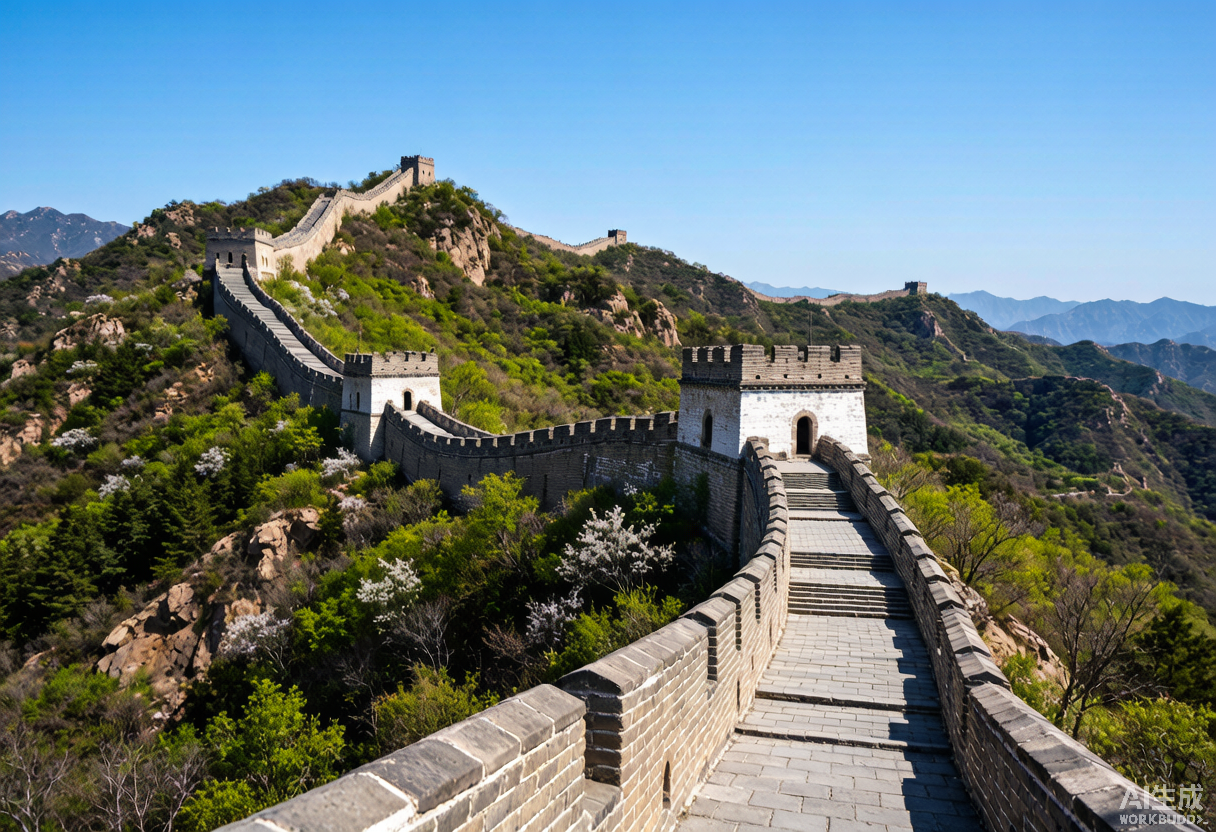
The architectural sophistication of the Mutianyu Great Wall is immediately evident to any visitor. Unlike simpler sections that feature only a single outer parapet, Mutianyu is renowned for an unusual dual-wall design: both the inner (south-facing) and outer (north-facing) edges of the wall are lined with crenellated battlements, complete with alternating merlons and embrasures. This engineering choice was deliberate and highly strategic. If attacking forces somehow breached the outer line, defenders could reposition behind the inner parapet and continue to fight, effectively creating a two-tiered system of defense. This double-sided crenellation is one of the rarest surviving features along the entire Great Wall, and it makes the Mutianyu Great Wall architecturally unique.
Equally impressive are the watchtowers, of which over 20 survive within the 2.25-kilometer fully restored section. These are not uniform boxes; they vary in size, shape, and function. The most iconic are the three-tiered “command towers” that rise dramatically from the ridge line, some of which are connected by small flying bridges to the wall itself. Dense corner towers, rectangular bastions, and hollow “passage towers” were built to house garrison troops, store weapons, and provide elevated vantage points for signaling. Soldiers stationed at the Mutianyu Great Wall were equipped with a sophisticated communication network: smoke signals by day and beacon fires by night, with some sources indicating that the mix of signals could convey the approximate size and direction of an approaching enemy force. The wall’s construction materials also deserve attention. The base was built with massive granite blocks, quarried locally, which provided a stable platform against earthquakes. Above this, the builders used large, specially fired bricks bonded with a mortar made from sticky rice flour and slaked lime—an ancient recipe that produced a binding agent of astonishing strength and durability, resistant to erosion for centuries.
Strategic Significance
The strategic importance of the Mutianyu Great Wall cannot be overstated within the larger framework of Ming defense. Its location was chosen to protect a narrow valley passage that led directly toward the heartland of Beijing, the Ming capital. While the wall meandered along the steep, forested mountains west of the Gubeikou pass, Mutianyu controlled the central high ground from which any invading cavalry column would be extremely vulnerable to attack from above. In conjunction with neighboring fortresses like Jiankou and Huanghuacheng, this section formed a continuous, unbroken defensive belt that forced any would-be invader into a near-impossible choice: assault steep mountain defenses directly, or take a long and dangerous detour through even more rugged terrain.
Ancient records from the Ming military archives indicate that the Mutianyu Great Wall was garrisoned by elite troops of the Qi family army, a force personally trained by General Qi Jiguang. These were not conscripted local farmers; they were professional soldiers drilled in combined arms tactics using bows, fire lances, and early cannons. The wall at Mutianyu was also integrated into a wider early warning network. By transmitting fire signals from one tower to the next along the ridge, a warning could travel from the frontier to the Forbidden City in a matter of hours—a remarkable speed for the 16th century. Because this section protected the capital directly, it received priority funding and the best military architects, which explains why the Mutianyu Great Wall outshines more remote sections in terms of structural refinement and remains historically significant today.
What to See Today
Today, the Mutianyu Great Wall offers what many consider the most rewarding visitor experience of any Great Wall section near Beijing. The restored area stretches roughly 2.25 kilometers from Tower No. 1 (Dajiao Lou) in the west to Tower No. 20 in the east, covering a vertical climb of more than 200 meters. The surrounding landscape is lush and forested, with forest coverage exceeding 90% in the region. In spring, cherry and peach blossoms frame the battlements, while in autumn the hillsides explode into fiery shades of red and gold. Because it is less crowded than Badaling, visitors can walk the ramparts without the disorienting crush of crowds.
Among the most remarkable sights is the “Great Corner Tower” (Tower No. 1), a massive two-story structure that also served as a connecting hub where the western and eastern sides of the wall form a striking, angular bend. Nearby, the “Tower of the Arrow” (Tower No. 14) is a multi-tiered watchtower with large arched windows, the restoration of which was aided by American Hollywood figures during a high-profile 1984 restoration project, making it a favorite spot for photographs. The walk between the two can take two to three hours, with a steady stream of steep stairways and shifting elevation that rewards hikers with panoramic views of the Yanshan peaks disappearing toward the horizon.
Visiting Tips
To make the most of your visit to the Mutianyu Great Wall, careful planning is essential. The site is located about 70 kilometers north of central Beijing, roughly a 1.5- to 2-hour drive depending on traffic. There is no direct subway access, so most visitors take a private car, a taxi, or one of the many direct tourist buses that depart from Dongzhimen in the city. Arrive early—opening time is generally 8:00 a.m. (or 7:30 a.m. in high season)—to experience the wall before tour groups flood the area. Avoid Chinese national holidays (especially Golden Week in October) when the site can become saturated.
For the physically ambitious, hiking up to the wall on foot from the ticket entrance takes about 20 to 30 minutes. However, there are two easier options: a modern cable car that rises to Tower 14 (near the highest restored point), and a more traditional open chairlift that arrives at Tower 6. The famous toboggan run—a 1,580-meter stainless steel slide that winds down the mountain from Tower 6—adds a dose of childhood fun to the descent and is a highlight for many visitors. Remember to bring water and wear sturdy walking shoes; the uneven Ming-era brick steps, some of which are over a foot high, demand respect. Finally, note that the westernmost towers (including the famous un-restored wild wall toward Jiankou) are officially off-limits, so stay within the marked boundaries. With a little preparation, the Mutianyu Great Wall provides not just an unforgettable view, but a deep, visceral connection to the ingenuity and resolve of the civilization that built it.