Historical Background
The Jinshanling Great Wall stands as one of the most extraordinary surviving remnants of China’s Ming Dynasty frontier defense system. Located in Luanping County, Chengde, Hebei Province, this section snakes across the rugged Yanshan Mountains, approximately 130 kilometers northeast of Beijing. Its history begins in 1368, the very first year of the Ming Dynasty, when the Hongwu Emperor ordered the construction of a counter-moat and rammed-earth wall to guard the northern approaches to the capital. However, the section visitors marvel at today owes its iconic form to the late 16th century, when the famed general Qi Jiguang was appointed commander of the Jizhou Garrison, the military district responsible for defending Beijing’s eastern and northern flanks.
Qi Jiguang, a brilliant military strategist and reformer, recognized that the existing earthen ramparts were no match for Mongol cavalry raids. Between 1567 and 1583, he oversaw a comprehensive reconstruction program along 1,200 kilometers of the Great Wall, with Jinshanling serving as a primary showcase. His laborers replaced crumbling earth with sturdy brick and stone, added dozens of elevated watchtowers, and engineer-designed moats to slow enemy horses. The result was a formidable, layered defense network that would remain operational for over four centuries. Although the wall’s military importance faded after the Ming Dynasty collapsed in 1644, the Jinshanling Great Wall survived the centuries largely intact, spared from the severe erosion and human damage that affected other sections. In 1987, UNESCO recognized the entire Great Wall, including Jinshanling, as a World Heritage Site, cementing its status as a global cultural treasure.
Architectural Features
What sets the Jinshanling Great Wall apart from other Ming-era sections is its extraordinary architectural density and diversity. Over its 10.5-kilometer length, the wall features 67 watchtowers, 5 beacon towers, 3 garrisons, and 4 defensive platforms—an astonishing concentration of military infrastructure. The towers come in multiple designs: hollow towers with wooden floors, solid stone towers, and two-story brick structures with vaulted ceilings and observation decks. This variety was no accident; Qi Jiguang ordered his architects to adapt each tower to its specific terrain, so no two towers are exactly alike.
One of the most distinctive features of the Jinshanling Great Wall is its multiple defensive layers. The main wall rises between 6 and 7 meters tall, with a base width of roughly 5 meters, wide enough for five horses or ten soldiers to march abreast. Along the outer parapet, crenulations provided archers with protected firing positions, while an inner wall offered low cover for troops moving along the top. Below the parapet, arrow slits angled downward to create a deadly crossfire against attackers scaling the base. The most ingenious defensive element, however, is the “horse-blocking wall” (Chăngmaqiáng), a 1.2-meter-high secondary barrier running parallel to the main wall at the top. This low wall was designed to stop charging horsemen and force soldiers to dismount, making them easy targets for defenders.
Equally impressive is the water drainage system. Every few meters, stone gutters and drainage spouts channel rainwater off the walkway, preventing erosion and structural damage. The bricks themselves were kiln-fired at extreme temperatures, producing dense, weather-resistant units that have withstood five centuries of snow, rain, and freeze-thaw cycles. Visitors also notice the “flat-topped” sections and steep “climbing-wall” slopes, reflecting the builders’ ability to adapt to gradients of up to 70 degrees. In many places, the inner parapet features metal plaques bearing the names of the construction units and dates, a form of 16th-century quality assurance that still reads clearly today.
Strategic Significance
The strategic role of the Jinshanling Great Wall cannot be overstated. It guarded the Gubeikou Pass, a critical gateway through the Yanshan Mountains that had historically served as a main invasion route for Mongol and later Jurchen forces. If an enemy breached this corridor, they could advance directly toward Beijing across the northern plains—a threat the Ming court took extremely seriously. The Jizhou Garrison under Qi Jiguang was considered the empire’s most elite defensive force, and Jinshanling formed its linchpin.
Architecturally, Jinshanling’s defense-in-depth approach reflected a sophisticated understanding of early modern siege warfare. The wall was not a passive barrier but an integrated fire-and-maneuver system. Beacon towers relayed smoke signals by day and fire signals by night, warning the capital of an attack within hours. Garrison towers housed up to 30 soldiers each, billeted with enough grain, water, and arrows to sustain a week-long siege. Below the wall, a network of “dividing walls” (Zichiang) funneled attackers into killing zones where crossbowmen and trebuchets could concentrate fire. This redundancy ensured that even if one segment fell, adjacent towers could isolate the breach and launch counterattacks. Historians credit Jinshanling’s design with preventing any major Mongol breakthrough into the Beijing region for nearly a century, a remarkable achievement given that earlier Ming walls had been breached repeatedly.
What to See Today
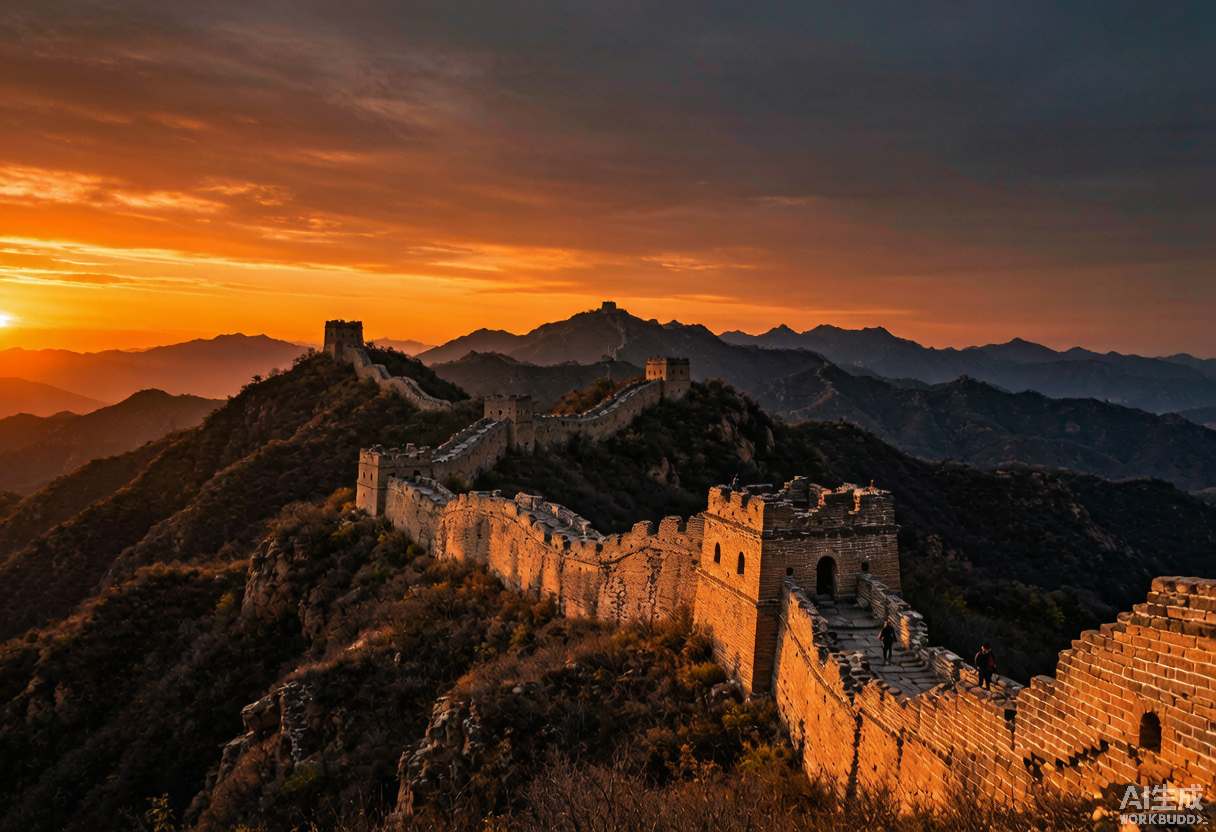
Today, the Jinshanling Great Wall offers a unique blend of restored and “wild” (unrestored) sections, making it a favorite among photographers and serious hikers. The restored portion, running approximately 3 kilometers from the main entrance toward Simatai, features rebuilt battlements, wooden watchtower floors, and freshly paved walkways—allowing visitors to experience the wall as it looked in Qi Jiguang’s heyday. Beyond this, the wild section stretches ruggedly across steep ridges, with crumbling towers and dense brush that create an authentic, romantic atmosphere of abandonment.
Must-see landmarks include the “General Tower” (Jiangjun Lou), a large two-story hollow tower offering panoramic views over the valleys below; the “Peach Blossom Tower” (Taohua Lou), named for the wild peach trees that bloom around it each April; and the “Glass Tower” (Boli Lou) at the highest elevation (roughly 1,050 meters), where the views are nothing short of breathtaking. Sunrise is a particularly magical time, when thick morning fog often fills the ravines, leaving the wall floating like a dragon’s spine above a sea of clouds. In autumn, the surrounding hills explode into crimson and gold, while winter snows lend a stark, dramatic beauty.
Visiting Tips
To fully appreciate the jinshanling great wall, plan a full day and start early. The park opens at 8:00 AM (opening hours vary by season, so check in advance). Wear sturdy hiking shoes with good grip—the restored section is easy, but the wild section involves steep, uneven stone steps that demand caution. Bring water and snacks, as vendors are scarce beyond the entrance area, though you will occasionally find local farmers selling bottled drinks at the main towers. Sunscreen and a wide-brimmed hat are essential in summer; in winter, layered clothing and gloves are mandatory, as the exposed ridgeline is windy and cold.
The best seasons to visit are late spring (May–June) and autumn (September–October), when temperatures are mild and skies are clearest. Summer brings heat and afternoon thunderstorms, while winter offers solitude and stark scenery. For photographers, a telephoto lens is useful for capturing distant towers, and a wide-angle lens is perfect for the dramatic ridgeline curves. If you are physically fit, consider hiking the 3-hour route from Jinshanling to Simatai West, a challenging but unforgettable trek that crosses the most spectacular terrain. Alternatively, a cable car (operating seasonally) can carry you up to the restored section with minimal effort.
Getting to the jinshanling great wall from Beijing typically takes 2.5 to 3 hours by car or bus. Many visitors book a guided day tour that includes transport and a local storyteller, which is highly recommended for historical context. Public buses from Beijing’s Miyun area also reach the site, but they require multiple transfers. If you arrive late, consider staying overnight in one of the simple family-run guesthouses at the foot of the mountain—this allows you to see the sunrise, the most photogenic time of day. Finally, respect the site: do not climb on damaged towers or remove bricks, as these relics are irreplaceable treasures. By following these tips, your visit to the Jinshanling Great Wall will be a safe, enriching journey into one of China’s most majestic historical landmarks.