Historical Background
Nestled in the rugged mountains of Miyun District, roughly 120 kilometers northeast of Beijing, the gubeikou great wall stands as one of the most strategically vital and historically layered fortifications in all of China. Unlike the heavily restored sections at Badaling or Mutianyu, Gubeikou offers a raw, authentic glimpse into the Ming Dynasty’s frontier defense system — a place where the walls still bear the scars of centuries of conflict.
Gubeikou — whose name translates to “Ancient North Mouth” or “Northern Pass” — has guarded the approaches to the North China Plain since antiquity. The earliest fortifications here date to the Northern Qi Dynasty (550–577 CE), when a crude earthen wall was first heaped along the mountain ridgelines. However, the stone-and-brick masterpiece visitors contemplate today was primarily constructed during the Ming Dynasty (1368–1644), specifically under the supervision of the legendary general Qi Jiguang. Appointed to oversee the northern frontier in the 1560s, Qi Jiguang rebuilt and reinforced vast stretches of the wall, transforming Gubeikou into a formidable military bastion designed to repel Mongol cavalry raids from the steppes beyond.
History remembers Gubeikou for two pivotal moments. In 1368, Ming founder Zhu Yuanzhang’s forces drove the defeated Mongol rulers northward through this very pass. Yet the most haunting episode occurred in 1644, when the rebel leader Li Zicheng breached the gubeikou great wall with relatively little resistance — the Ming soldiers were demoralized and underpaid. That same year, the Manchu armies of the Qing Dynasty swept through the same gap, ushering in a new imperial era. For over a thousand years, Gubeikou remained the principal funnel through which northern invaders and traders alike traveled, making it the undisputed “Key to the North” in Chinese military geography.
Architectural Features
The architectural complexity of the gubeikou great wall sets it apart from nearly every other segment of the Ming fortifications. The wall here runs for approximately 20 kilometers, but its most celebrated elements are the extraordinary Wohu (Crouching Tiger) and Panlong (Coiled Dragon) mountain sections, which face each other across the deep Chao River valley.
Perhaps the most famous structure within this segment is the 24-Eye Watchtower — the “Wohu Lou” — perched atop Wohu Mountain. This massive hollow three-story tower derives its name from the 24 arrow-slit windows (eyes) that pierce its upper levels, providing archers and cannoneers with overlapping fields of fire in every direction. Though now crumbling, the tower’s scale remains breathtaking; it once accommodated dozens of soldiers and stored enough grain and gunpowder to withstand prolonged sieges. Nearby sits the equally iconic “One-Wall-Two-Sides” feature: a double-layer wall system that runs along the mountain spine, with defensive crenellations on both the north and south faces. This rare design meant that even if attackers managed to scale the wall, defenders could pivot and continue fighting from the opposite parapet.
Gubeikou’s architects exploited the terrain with extraordinary skill. On steep cliffsides, the wall narrows to a mere 1.5 meters, while on gentler slopes it widens to 5 meters — enough to allow five horsemen to ride abreast. The core is rammed earth, faced with granite blocks and large grey bricks bonded by a glutinous rice-lime mortar that has proven astonishingly durable over four centuries. Beacon towers, signal platforms, and soldier barracks are spaced at regular intervals, each connected by stone staircases that seem to defy gravity. Water was channeled through hidden drains beneath the wall, and every gate was fitted with a trap-style defense system known as a “wengcheng” (jar city) — a small enclosed bailey where invading forces could be trapped and annihilated from all sides.
Strategic Significance
Military strategists throughout the Ming Dynasty regarded Gubeikou as the single most important defensive position within the entire Jizhen (Jizhou) military district. The reason is simple geography: this is the closest gap in the Yanshan mountain range to the Ming capital of Beijing. Whereas northern barbarians attacking through other passes like Juyongguan or Simatai faced long, grueling journeys through hostile terrain, Gubeikou offered a relatively gentle corridor that funnels directly onto the North China Plain — a mere three-day forced march from the imperial capital.
To compensate for this vulnerability, the Ming deployed a layered defense strategy. The front line at Gubeikou was supported by a secondary wall line, roughly 10 kilometers behind, along with hundreds of permanently garrisoned troops. Ming military registers from the Wanli period (1573–1620) record more than 5,000 soldiers stationed at Gubeikou alone, supported by thousands more at nearby outposts. These troops maintained standing patrols, operated signal fire beacons, and conducted regular drills. The pass was also a crucial logistical chokepoint: whoever controlled Gubeikou controlled the movement of trade goods, spies, and armies between the steppe and the plains.
The strategic lessons of Gubeikou echoed well beyond the Ming era. During the 1933 Battle of Rehe, Chinese nationalists attempted — with tragic futility — to hold the same pass against an invading Japanese army. Today, historians study Gubeikou as a textbook example of Ming frontier engineering, a defensive system so well conceived that its only fatal weakness was the political rot of the dynasty that built it.
What to See Today
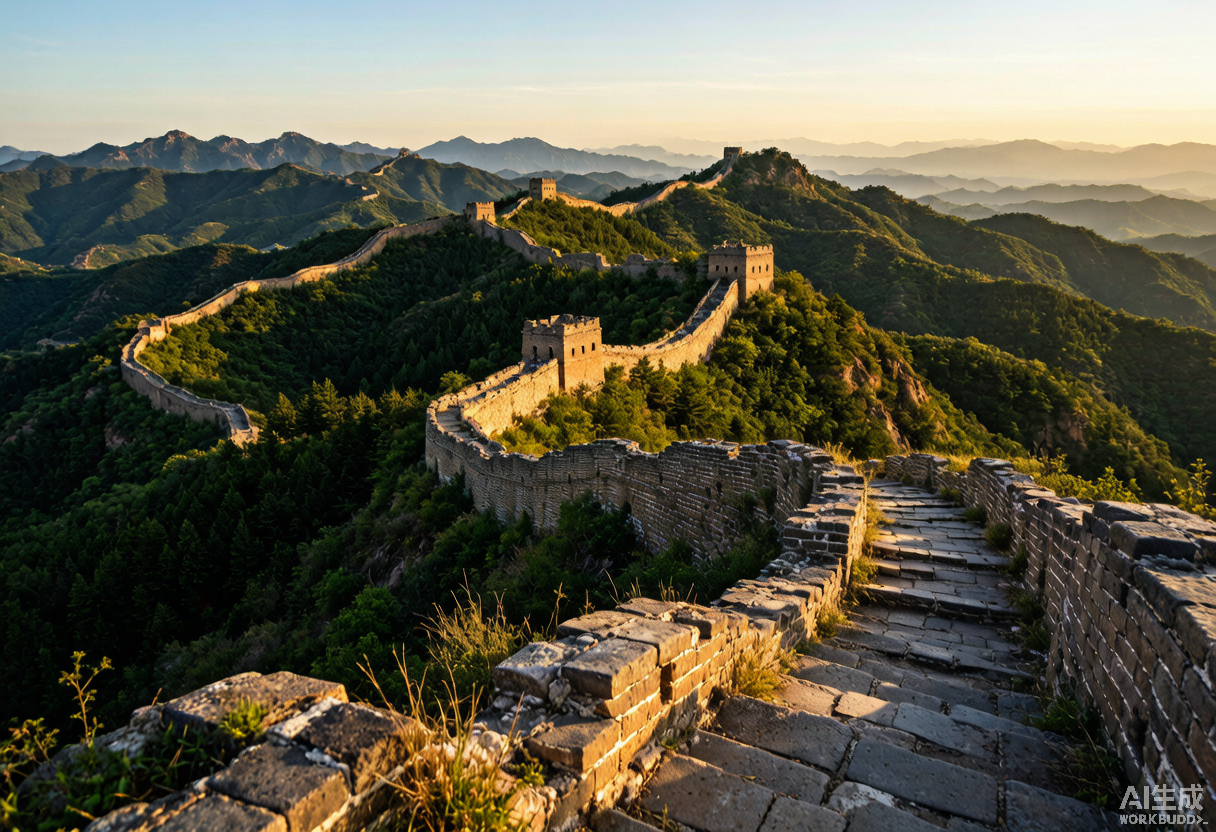
Visiting the gubeikou great wall today is akin to walking through a living museum of military archaeology. Unlike the polished pavements of restored sections, the walls here are unrestored “wild” walls, cloaked in scrub brush and wild apricot trees, their brick surfaces weathered into sculptural forms. The most dramatic hiking route begins at the Panlong Mountain trailhead, ascending through four primary watchtowers before crossing the valley floor to the 24-Eye Tower on Wohu Mountain. The climb is strenuous — expect loose stones, steep staircases, and sections where the wall has collapsed entirely — but the rewards are immense.
From the 24-Eye Tower, hikers are treated to an astonishing panorama: the wall snakes across the ridgelines in both directions like a great stone dragon, with the green Chaoyang River glinting far below. To the east, an uninterrupted stretch of wall connects to Jinshanling and Simatai, creating one of the longest continuous wild-wall hiking routes in all of China. In spring, the slopes burst with peach and apricot blossoms; in autumn, the mountainsides blaze with gold and crimson foliage. Photographers will find sunrise and late afternoon light particularly magical, as the low sun casts deep shadows across the fractured watchtowers, revealing details invisible during the harsh midday sun.
Visiting Tips
To make the most of a visit to the gubeikou great wall, plan for a full day and prepare as you would for a wilderness hike. The nearest public access points are in the villages of Gubeikou and Bakeshiying, both reachable by private car or taxi from Beijing — roughly a 2.5-hour drive. There is no high-speed rail directly here, so most independent travelers hire a driver or join a small tour group. Entrance fees are minimal (around 25 RMB), though this wild section has no formal ticket office for all entrances, so check current conditions in advance.
Sturdy hiking boots with aggressive tread are essential; the worn stone steps can be treacherously slick after rain. Bring plenty of water, snacks, and sun protection, as there are no vendors on the wall. The ideal visiting season is from April to June or September to November, when temperatures are moderate and skies are clear. Summer brings sweltering heat and heavy thunderstorms, while winter winds whip across the ridges with brutal force and snow can obscure the narrow paths. Respect the fragility of the site: the gubeikou great wall remains unprotected by UNESCO oversight, and its crumbling fabric relies on visitors to avoid removing bricks, carving names, or scrambling off established trails. Carry out every piece of trash, support local caretakers, and leave this thousand-year monument exactly as you found it — wild, wounded, and profoundly majestic.