Historical Background
The Badaling Great Wall stands as the most famous and best-preserved section of the Great Wall of China, a UNESCO World Heritage Site that has come to symbolize the resilience and ingenuity of Chinese civilization. Located in Yanqing District, approximately 70 kilometers northwest of Beijing’s city center, this formidable fortification was constructed during the Ming Dynasty (1368–1644), a period characterized by intense military conflict and a renewed commitment to defending the northern borders against Mongol and other nomadic incursions.
While earlier dynasties, including the Qin (221–206 BCE) and Han (206 BCE–220 CE), built rudimentary walls along these mountain ridges, the Badaling Great Wall as visitors see it today dates primarily to the Hongzhi Emperor’s reign (1487–1505) and was extensively reinforced throughout the 16th century. The name “Badaling” translates roughly to “Eight Peaks” or “Eight Ridges,” a reference to the eight mountain summits along which the wall undulates dramatically. This location was chosen with brilliant foresight, as Badaling occupies the Juyongguan Pass, a critical choke point in the Jundu Mountains that guarded the northwestern approaches to the imperial capital of Beijing.
Throughout the Ming Dynasty, the Badaling Great Wall served not merely as a passive barrier but as an active military command center. Historical records indicate that more than a dozen Ming emperors personally inspected the defenses here, and the wall’s garrison frequently exceeded 10,000 troops. During the Tumu Crisis of 1449, when the Oirat Mongol leader Esen Khan captured the Ming emperor Zhengtong, the Juyongguan Pass and its Badaling defenses became the last line of defense before the capital itself. The wall’s reputation as an impenetrable bulwark was tested repeatedly, and its mere presence often discouraged would-be invaders from attempting a direct assault.
Architectural Features
The architectural sophistication of the Badaling Great Wall reveals the Ming Dynasty’s mastery of military engineering. Stretching approximately 7.6 kilometers in length at Badaling, the wall rises to an average height of 7.8 meters, with a base width of 6.5 meters that narrows to 5.7 meters at the top—a trapezoidal profile that ensures structural stability against seismic activity and the region’s harsh winter winds. The entire structure is composed of massive blue-grey bricks, each weighing approximately 15 kilograms, fused together with a mortar made from lime and glutinous rice flour, a remarkably durable composite that has survived for over five centuries.
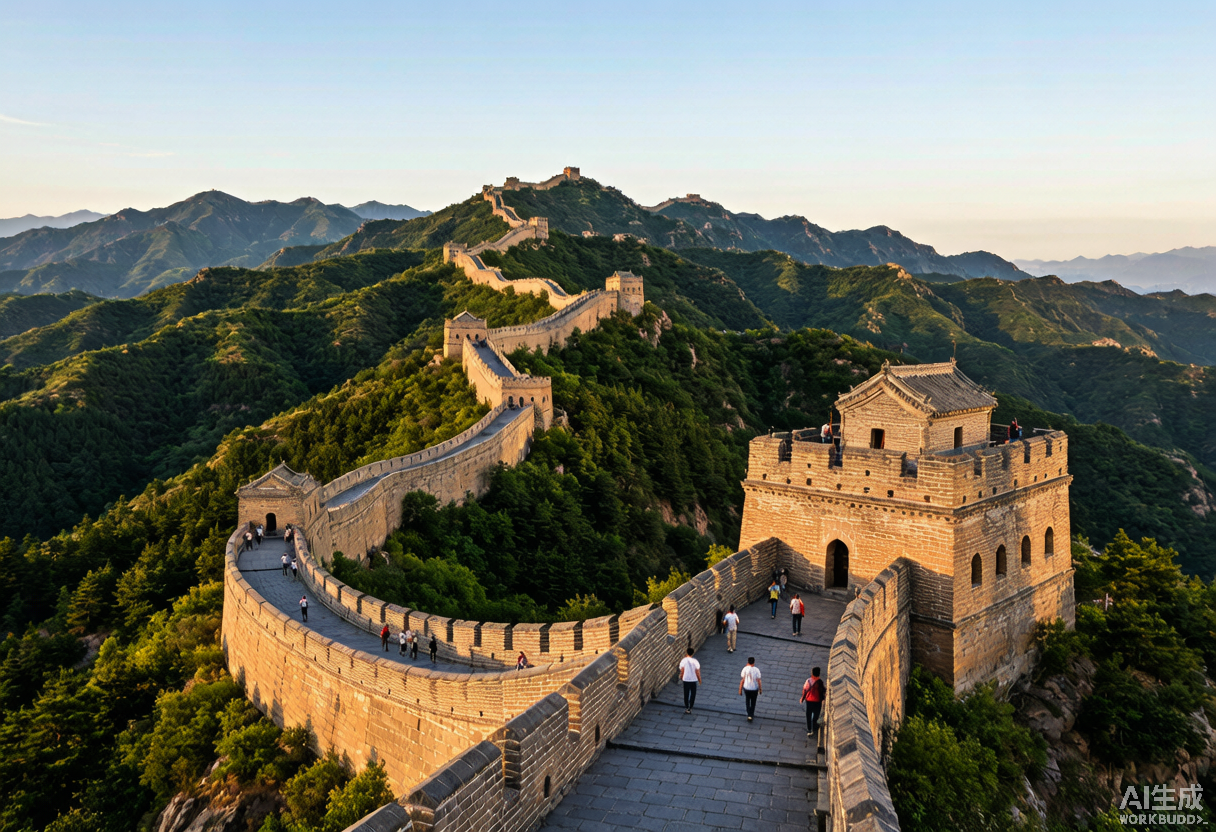
Visitors walking along the ramparts immediately notice the crenellated parapets that line both sides of the wall. The outer parapet, on the mountain-facing side, features the iconic zigzag pattern of merlons and crenels, allowing defenders to fire arrows while remaining shielded from incoming projectiles. Below these crenellations, small square loopholes called “arrow windows” are spaced at regular intervals, engineered to provide overlapping fields of fire. The inner, or Beijing-facing, parapet is lower and simpler, designed primarily to prevent soldiers from accidentally falling rather than for defensive purposes.
Every 300 to 500 meters along the Badaling Great Wall, visitors encounter impressive two-story watchtowers. These structures, known as “dilou” or enemy-watching towers, measure roughly 10 meters square and 12 meters in height. The ground floor functioned as living quarters for soldiers, complete with fireplaces for cooking and heating, while the upper floor provided an elevated observation platform with panoramic views in all directions. Small openings in the watchtower walls were designed for anti-personnel weapons, including early versions of fire lances and exploding gunpowder projectiles. Communication between towers was achieved through a sophisticated system of smoke signals by day and beacon fires by night, enabling a message to travel from Badaling to the Forbidden City in under an hour.
Strategic Significance
The strategic importance of the Badaling Great Wall cannot be overstated. It guarded the Juyongguan Pass, which was the shortest and most direct route between the Mongolian steppe and the North China Plain. Unlike many other wall sections that meandered across remote wilderness, Badaling protected a vital economic artery—the ancient Silk Road trade route. Control of this pass meant control of trade, and the wall’s customs posts levied substantial taxes on caravans carrying silk, tea, porcelain, and horses, generating significant revenue for the imperial treasury.
Geographically, the wall at Badaling follows the “ridge-line strategy” perfected by Ming military engineers. By building upon the highest ridgelines, the wall provided defenders with an unobstructed line of sight extending tens of kilometers in every direction. Approaching Mongol cavalry would be visible hours before they reached the fortifications, giving garrison commanders ample time to light beacon fires, mobilize reserves, and prepare defensive formations. The steep mountain slopes themselves, often exceeding 45 degrees, were nearly impassable for mounted warriors, channeling attackers into narrow valley approaches where the wall’s defensive firepower was most concentrated.
Furthermore, the Badaling Great Wall functioned as a sophisticated early warning and logistics network. Each watchtower housed signaling equipment, including dried wolf dung for smoke signals (chosen for its thick, visible smoke) and multiple beacon braziers. The number of fires lit corresponded to the size of the approaching enemy force—one fire for up to 100 raiders, two for 500, three for 1,000, and so forth. This system allowed Beijing’s defenders to know the exact scale of an invasion hours before the enemy even reached the outer defenses, enabling the emperor to activate the capital’s garrison and deploy the feared Shenji Ying (Divine Engine Division) artillery units.
What to See Today
Today, the Badaling Great Wall is the most visited section of the Great Wall, attracting over 10 million tourists annually and serving as the venue of choice for visiting heads of state, from Queen Elizabeth II to Barack Obama. The entire site has been meticulously restored, with the most heavily trafficked section between the East (Dong) and West (Xi) Beacon Towers offering a faithful recreation of its Ming Dynasty appearance. The Southern and Northern routes diverge at the entrance; the Northern route is longer and more challenging, ascending to the panoramic “Sky Capital” (Tiankong) at 1,015 meters above sea level, while the Southern route is gentler yet offers equally breathtaking views of the undulating wall disappearing across the ridgelines.
In 2024, a newly expanded exhibition hall opened near the South Ticket Gate, showcasing over 2,000 archaeological artifacts excavated from the Badaling Great Wall site, including Ming Dynasty weaponry, ceramic vessels, and the original glazed roof tiles that once topped the watchtowers. For those wishing to explore beyond the tourist zone, a cable car carries visitors to the North Eighth Watchtower, while the less-crowded western extension toward the Zhengguan Platform provides a more rustic experience where the wall runs wild and unreconstructed.
The surrounding Badaling Wildlife World, located adjacent to the wall, offers a complementary attraction featuring Siberian tigers, snow leopards, and other species native to the region’s high-altitude forests. Meanwhile, the Great Wall Museum of China, built in a striking modern architectural style at the entrance plaza, provides immersive exhibits on the wall’s construction techniques through interactive holograms and full-scale replicas of Ming siege engines.
Visiting Tips
First-time visitors to the Badaling Great Wall should allocate at least four hours to explore the site properly. The wall opens at 6:30 AM (7:00 AM in winter) and closes at 6:00 PM, and arriving before 9:00 AM is strongly recommended to avoid the worst crowds, which typically peak between 10:00 AM and 2:00 PM, especially during Chinese national holidays when daily attendance can exceed 80,000. The metro does not extend to Badaling, but a dedicated high-speed railway—the Beijing–Zhangjiakou Intercity Railway—now connects Qinghe Railway Station in northern Beijing to Badaling Great Wall Station in just 22 minutes. Alternatively, public bus routes 919 and 877 depart frequently from Deshengmen Gate in Beijing, with a travel time of roughly 90 minutes.
Physical preparation is essential. The ramparts at Badaling include sections with an incline exceeding 60 degrees, and the stone steps are uneven after centuries of wear. Comfortable, non-slip walking shoes are mandatory, and visitors with mobility concerns should take advantage of the cable car (for the Northern route) or the new escalator system that bypasses the steepest initial ascent. During winter, the wall’s exposed position means temperatures can drop 10 degrees Celsius below Beijing’s city center, while summer afternoons offer no shade whatsoever—bring layered clothing and at least one liter of water per person. To capture experiential authenticity without the crowds, consider taking the walking trail from the nearby Wild Great Wall section, which diverges from the main tourist path and offers a quieter, more contemplative encounter with these ancient frontier defenses.