Historical Background
Nestled within the rugged Taihang Mountains of Hebei Province, the Zijingguan Pass (紫荆关) stands as one of the most formidable and historically significant fortifications of the Ming Dynasty Great Wall. Known as the “Purple Thorn Pass,” its name derives from the dense thickets of purple-flowering redbud trees that blanket the surrounding slopes—a delicate name for a structure of immense military might. While the earliest defensive works at this strategic mountain gorge date back to the Warring States period (475–221 BCE), the Zijingguan Pass we recognize today is almost entirely the product of Ming Dynasty engineering, particularly from the mid-15th century onward. Following the catastrophic Tumu Crisis of 1449, when the Oirat Mongols captured the Ming emperor himself, the imperial court realized that the outer Great Wall was not an impenetrable shield. In response, the Ming state poured immense resources into strengthening a secondary belt of fortifications—the famed Inner Three Passes (内三关)—of which Zijingguan was a vital pillar alongside Juyongguan and Daomaguan.
The pass reached the height of its prominence during the 16th and 17th centuries, as Ming military architects methodically upgraded its walls, gate towers, and beacon systems. Historical records from the Jiajing period (1521–1567) document major expansions that added multiple layers of defense and integrated the cliffside terrain into a cohesive fortress complex. Unlike the more celebrated Badaling section north of Beijing, which saw imperial visits and ceremonial grandeur, the Zijingguan Pass was above all a working military installation—a place of grizzled garrison soldiers, supply caravans, and ever-watchful sentries scanning the mountain horizons for signs of invading cavalry. It is this raw, uncompromising character that makes the pass such a compelling destination for those seeking to understand the Great Wall beyond its tourist-postcard image.
Architectural Features
The architectural design of the Zijingguan Pass is a masterclass in adaptive military engineering, exploiting natural topography to create a fortress nearly immune to frontal assault. The complex is divided into two primary concentric fortifications—an inner citadel and an outer rampart—sprawling across an elevated ridge that overlooks the rushing waters of the Juma River below. The main walls, constructed from massive, hand-hewn granite and limestone blocks packed around a rammed-earth core, rise to heights of roughly 30 feet in their best-preserved sections and measure up to 20 feet thick at their base. This formidable carapace was crowned with crenellated parapets and pierced by archer slits and cannon embrasures, allowing defenders to unleash devastating volleys on any enemy force attempting to storm the approaches.
One of the most distinctive architectural traits of the Zijingguan Pass is its concentric, stair-stepped layout. Rather than a single linear wall, the fortress comprises a network of overlapping defensive circuits that force attackers into narrow kill zones. The north gate, which faces toward the Juma River gorge and the ancient mountain road leading into Shanxi Province, was protected by a crescent-shaped barbican—a semi-circular outer fortification that funneled approaching troops into a tight, enclosed space where they could be fired upon from three sides simultaneously. Water defenses were equally critical: the Juma River served as a natural moat, while a system of stone-lined trenches and dry moats was carved across the flat approaches. Inside the walls, granaries, armories, barracks, and command residences sustained the garrison through prolonged sieges. Beacon and signal towers, positioned along the ridgelines, linked the pass to Juyongguan and the capital’s early-warning network, ensuring that intelligence of an attack could reach Beijing within hours.
Strategic Significance
In the defensive calculus of the Ming Dynasty, the Zijingguan Pass occupied a position of near-supreme importance. Geographically, the pass guards one of the most critical routes through the Taihang Mountains—the great natural barrier that separates the Shanxi highlands and the Inner Mongolian steppe from the fertile North China Plain. For centuries, invaders from the west and northwest—whether Mongol horsemen, rebel armies, or steppe confederations—could approach the Ming capital of Beijing along two principal corridors: the Juyongguan route from the north, or the Zijingguan route from the southwest. If Zijingguan fell, an enemy army could march directly toward Beijing across comparatively flat terrain, bypassing most of the heavily fortified passes that guarded the capital’s southern approaches. The strategic calculus was unforgiving: Zijingguan was, in effect, the last great locked door before the imperial capital.
The Ming military understood this vulnerability with painful intimacy. Officially designated one of the three Inner Passes, the Zijingguan Pass anchored the western hinge of Beijing’s second defensive ring, functioning not as an isolated outpost but as the linchpin of a coordinated defensive network stretching hundreds of miles. When the outer walls of the Great Wall along the northern frontier came under attack, garrison commanders at Zijingguan would mobilize reinforcements, light warning beacons, and prepare to receive troops withdrawn from outer positions. This dual role as both bastion and staging ground made the pass strategically vital to the empire’s survival. Moreover, control of Zijingguan meant control of the mountain road through which trade caravans, military reinforcements, and intelligence couriers passed between the capital region and the western provinces—a bottleneck whose loss would sever Beijing’s logistical lifelines and expose the capital to encirclement from an unexpected direction.
Notable Events & Legends
The most dramatic chapter in the history of the Zijingguan Pass unfolded in the autumn of 1449, during one of the greatest crises of the Ming Dynasty. In that year, the Oirat Mongol leader Esen Tayisi launched a massive invasion of Ming territory, decisively defeating the imperial army at the Battle of Tumu and capturing Emperor Yingzong himself. With the main field army annihilated and the emperor in enemy hands, Esen’s victorious forces turned toward Beijing. Before reaching the capital, however, they first had to contend with the staunch defenders of Zijingguan, where the garrison—operating under loyal commanders—repulsed wave after wave of Mongol assaults. The pass’s walls held long enough to buy the capital precious time, allowing the renowned minister Yu Qian to organize the legendary defense of Beijing’s city walls and ultimately save the dynasty from collapse.
The pass faced further tests in the following century. During the 1550s, Mongol raids led by Altan Khan probed the Zijingguan defenses, and dynasty chronicles record that the garrison withstood the onslaught, earning commendation from the imperial court. In the turbulent final years of the Ming Dynasty, the pass was also swept into the maelstrom of rebellion. When Li Zicheng’s rebel army overwhelmed northern China in 1644, the pass commanders—like so many Ming generals—were forced to choose between loyalty to a collapsing dynasty and accommodation with an ascendant rebel power. Local legend still whispers of a hidden tunnel beneath the fortress walls, a secret passage leading to the riverbank that was allegedly used by a Ming commander to evacuate his family during a desperate night of crisis. Whether historical truth or fanciful invention, the story captures the atmosphere of intrigue, peril, and endurance that defined life at this mountain stronghold for centuries.
What to See Today
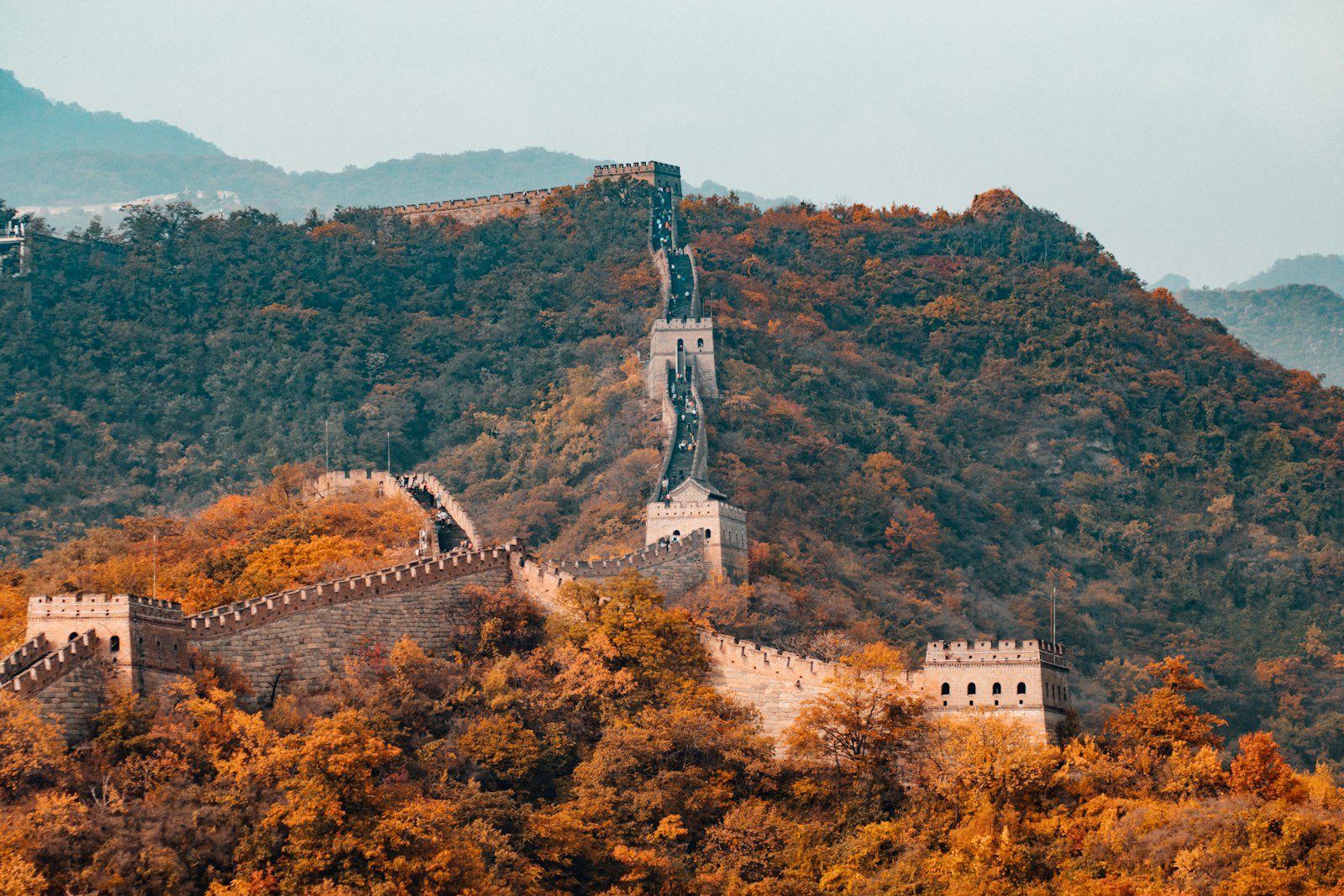
Unlike the crowded, meticulously restored sections of the Great Wall at Badaling or Mutianyu, the Zijingguan Pass offers a rawer, more evocative encounter with Ming Dynasty history. The site has undergone only partial restoration, preserving a haunting authenticity that transports visitors back in time. The most striking surviving structure is the north gate—a massive, arched stone portal with hefty wooden doors, crowned by stepped tiers of brick watchtower construction. The stone plaque above the gate, bearing the characters “Zijingguan” in bold Ming-era calligraphy, is a treasured piece of cultural heritage. Visitors can also explore long, crumbling stretches of the outer wall that snake dramatically up adjacent mountain cliffs, where ruined beacon towers still recall the smoke signals that once sent warnings across the valley.
The remnants of the old garrison settlement, with its stone-paved streets and weathered courtyard houses, sit within the fortress precinct, offering an intimate glimpse of frontier military life. Below the battlements, the Juma River continues its ancient course through the gorge, its clear waters contrasting with the grey severity of the stone above. The scenery is simultaneously beautiful and stark, evoking the harsh realities of the Ming frontier in a way that glossy restorations simply cannot. For photographers and history enthusiasts, the interplay of mountain geology, flowing water, and weathered military architecture creates countless dramatic compositions—particularly in the late afternoon, when low sunlight casts long shadows across the ruined battlements.
Visiting Tips
Reaching the Zijingguan Pass requires a deliberate journey, which is part of its appeal. The site lies approximately 130 kilometers southwest of central Beijing, near Yi County in Baoding Prefecture, Hebei Province. There is no direct high-speed rail connection; most visitors rent a car or charter a private vehicle, a drive of roughly 2.5