Historical Background
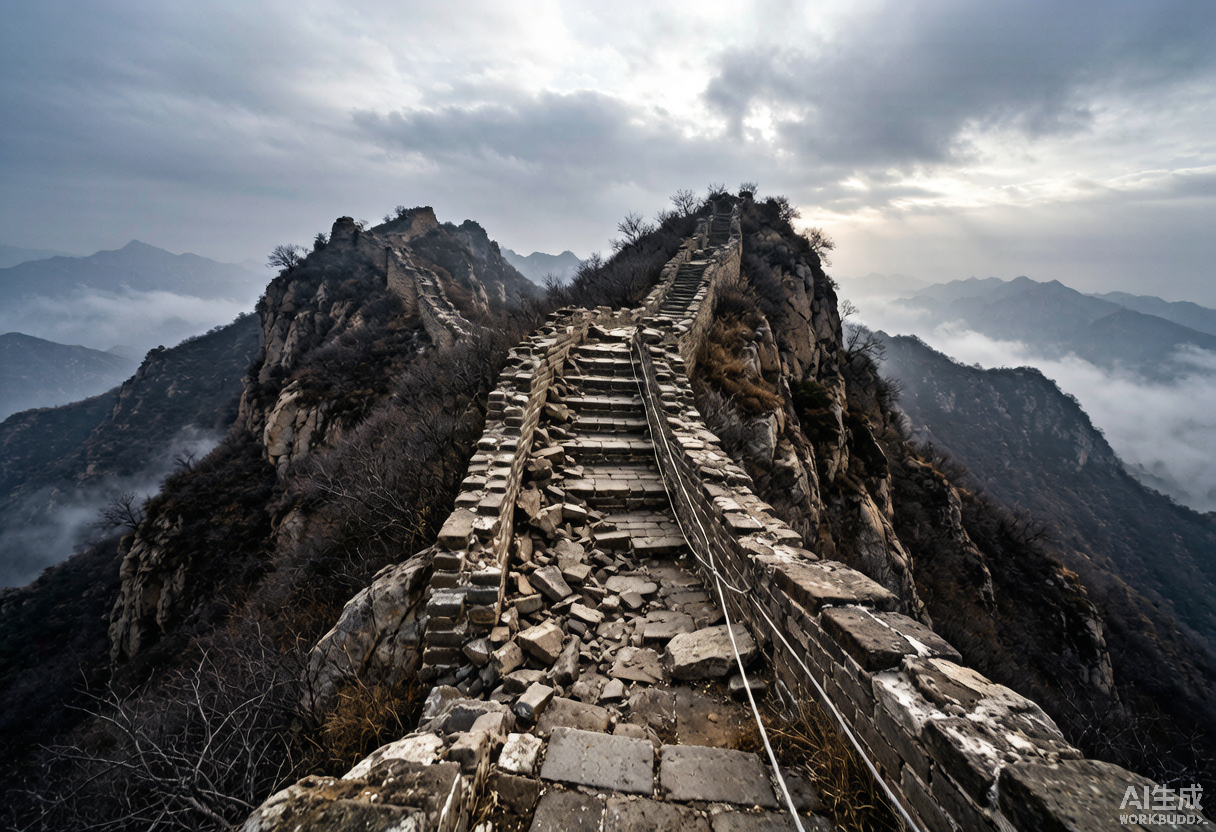
The Jiankou Great Wall stands as one of the most dramatic and untamed remnants of China’s Ming Dynasty frontier fortifications, snaking along the jagged ridgelines of the Yanshan Mountains in Beijing’s Huairou District, approximately 60 kilometers north of the capital. Unlike the meticulously restored sections such as Badaling or Mutianyu, Jiankou remains a wild, crumbling masterpiece, cherished by hikers, photographers, and history enthusiasts for its raw authenticity. Its name, literally meaning “Arrow Nock,” derives from the V-shaped notch of a mountain peak that resembles the notch at the end of a bow where the arrow rests—a fitting name for a structure once devoted to arrow and shot.
Constructed during the mid-Ming Dynasty, primarily under the reign of the Longqing Emperor (r. 1567–1572) and continued through the Wanli era, the Jiankou section owes much of its current form to the legendary general Qi Jiguang. Appointed as commander of the Jizhou military region, Qi oversaw a massive rebuilding campaign that transformed earlier, cruder earthen ramparts into the formidable brick-and-stone masonry fortifications visible today. Guild stonemasons from across northern China labored for decades, and the strategic importance of this stretch was paramount: the Jiankou wall guarded the narrow mountain corridors through which northern nomadic cavalry—most notably the Mongols—could sweep southward toward the Ming capital of Beijing. The wall at Jiankou was not a single continuous line; rather, it formed a complex network with inner and outer branches that converged at a point known today as the “Beijing Knot” (Beijing Jie). For over four centuries, this mountain fastness stood sentinel, its watchtowers manned by soldiers whose signal fires and smoke relays could flash warning messages across the hills with astonishing speed.
Architectural Features
The architectural audacity of the Jiankou Great Wall is breathtaking even by modern engineering standards. While the Great Wall as a whole spans multiple dynasties and construction styles, the Jiankou section exemplifies the Ming Dynasty’s mature masonry techniques: an inner core of rammed earth and gravel, faced on both sides with dressed limestone blocks and gray brick bonded by a lime mortar so resilient that it still holds in many places after 400 years of exposure. The wall climbs elevations ranging from 700 to over 1,300 meters, and in certain segments—most infamously the section known as “Eagle Flies Upward” (Ying Fei Yang)—the gradient approaches a staggering 70 to 80 degrees, forcing hikers to scramble on all fours over crumbled steps that were once perfectly laid.
Jiankou’s defensive design is equally sophisticated. The crenellated parapet along the outer edge features alternating merlons and embrasures, offering archers cover and firing slots for bows, crossbows, and early firearms. The inner side of the wall once boasted guardrooms, storage niches, and a wall-walk paved with brick, although centuries of frost, rain, and vegetation have erased much of the finer detail. Its crowning glories are the watchtowers—two-story brick structures with vaulted interiors, wooden beam floors (now long gone), and windows on multiple sides for 360-degree surveillance. The “Nine-Eyes Tower” (Jiuyan Lou), located on the western flank near the village of Xizhazi, is particularly famous for its nine openings—three on each of three facades—and offers a commanding panorama of the surrounding ranges. The towers’ design exemplifies the Ming military principle of layered defense: each tower could house roughly 30 soldiers, enough to deter small raiding parties and delay larger ones until reinforcements arrived from garrison towns below.
Strategic Significance
Of all the sections of the Great Wall, the Jiankou Great Wall occupies a uniquely critical position in the Ming defensive scheme. Its location placed it directly athwart the route from the Mongolian steppe into the North China Plain—a pass through which any army marching on Beijing would have to navigate. The wall’s builders exploited the steep terrain to exponential advantage: a defensive force of even a few hundred men holding the Eagle Flies Upward ridgeline could pour rocks, arrows, and gunfire onto attackers forced to ascend single-file through the ravines below. The “Beijing Knot” where Jiankou’s inner and outer branches intersect is not merely a scenic curiosity; it was a tactical junction that allowed commanders to shift troops laterally along either wall line, reinforcing threatened sectors without exposing themselves to enemy fire.
During the late Ming, this region became a front-line bulwark against the rising power of the Jurchen tribes (later the Manchus), who repeatedly probed the wall’s defenses in the decades before the dynasty’s fall. Historical records note that Qi Jiguang’s reforms—including the construction of hollow watchtowers at regular intervals, a groundbreaking innovation of the era—were tested rigorously at Jiankou. The towers were equipped with cannon platforms and served as both observation posts and fortified mini-fortresses, allowing soldiers to retreat, reload, and regroup even if the wall-walk was breached. The Jiankou section also functioned as part of a signal network: a beacon lit at its towers could be seen at the neighboring Huanghuacheng and Mutianyu sections, creating a chain of warning that stretched toward Beijing with relays every few kilometers.
What to See Today
Today, the Jiankou Great Wall is celebrated as the most photogenic—and least restored—stretch of the entire Great Wall system, a hauntingly beautiful ruin framed by steep cliffs, wild rhododendron, and ancient pine trees. The most iconic landmark is the aforementioned Beijing Knot, a massive ancient tree that grows directly out of crumbled masonry at the intersection of the wall’s three branches, surrounded by towers on all sides. From this pivot point, hikers can ascend to the Zhengbei Tower (a key 2014 restoration site), descend to the Kang Riyu Tower, or traverse the jaw-dropping ridge toward the Ox Horn Edge (Niu Jiao Bian) with its knife-edge spine of stone. The Nine-Eyes Tower, reached by a punishing climb, rewards visitors with perhaps the finest sunrise vista in the whole of the great frontier—a sea of clouds rolling over the stepped ramparts as dawn light ignites the stonework in gold and crimson.
Season each visit with the landscape: in spring, the mountain slopes foam with pale wild apricot blossoms; in autumn, the wall slices through a quilt of red maple, golden birch, and amber oak; in winter, ice hangs from the parapet and the silence is so total that the rustle of breeze feels thunderous. Photographers flock here at dawn and dusk, vying for angles that capture the wall’s rugged texture—lichen-stained bricks, gaping arrow slits, and twisted roots splitting ancient mortar—against the vastness of the Yanshan peaks. Note that due to crumbling sections and the danger of rockfalls, several areas have been officially closed for safety restoration, so it is essential to check the latest local access conditions before planning a route. Unauthorized climbing is prohibited in the strictest sense, though guided hiking on permitted paths continues to be offered by registered local outfitters.
Visiting Tips
The Jiankou Great Wall is a wild mountain experience, not a cultural theme park. It is not suitable for casual tourists, children, or anyone lacking solid fitness and a head for heights. To reach the area, travelers typically base themselves in Beijing and take a 2.5-hour drive north to the villages of Xizhazi or Zhuanghu, the two primary trailheads. There is no official ticket gate; access is managed by a cautious ecosystem of local guides who know the safest routes and the current status of unstable walls. Hiking times vary dramatically by itinerary: a day trip covering the Beijing Knot and nine-eyes tower takes 6–8 hours of strenuous ascent and descent, while overnight camping trips allow for two-day traverses ending at the restored Mutianyu section (from which you can take a cable car down).
Packing is non-negotiable: wear sturdy hiking boots with ankle support, bring gloves for the Eagle Flies Upward section where you may need to grip stone handholds, and carry at least 3 liters of water plus high-energy trail food. A trekking pole is helpful on descents, though it becomes a liability on near-vertical climbs. Start hiking before dawn to avoid midday heat and to catch the luminous morning light; by 3 p.m., experienced hikers begin descending to avoid being caught on the wall after dark, as there is no lighting and sections are perilous in twilight. The best seasons are late September to late October (cool temperatures and spectacular foliage) and mid-April to mid-May (blooming wildflowers), while July and August bring thunderstorms, slippery stone, and dense undergrowth—best avoided. Above all, hire a licensed guide; the Jiankou wall’s beauty is seductive, but its hidden ravines and crumbling exposed cliffs have claimed lives, and local expertise is the true key to standing safely among the centuries-old stones of this extraordinary monument.