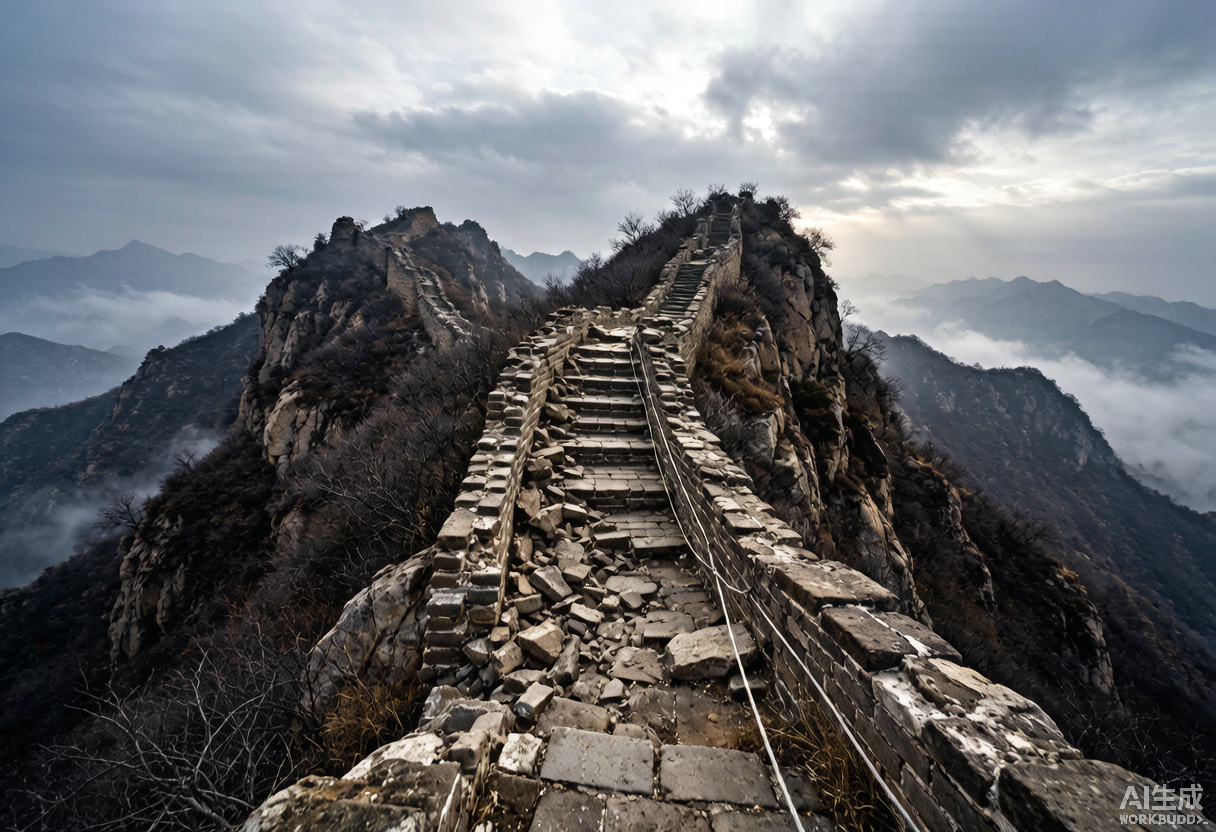
The Setting
North of Beijing, past the orderly scarlet battlements of Mutianyu, the Great Wall sheds its polished identity and becomes something older, wilder, and far less forgiving. Here, along the jagged crests of the Yanshan Mountains in Huairou District, rises Jiankou (箭扣)—a section of the wall named for the arrow-shaped notch that cleaves its silhouette against the rising sun. For those who dare its crumbling ramparts, this is “the wild wall hiking jiankou’s forbidden ridge,” a stretch of Ming Dynasty masonry that has survived not because it was loved but because it was forgotten. No ticket booths, no guardrails, no souvenir stands. Only the wall, the wind, and the long silence of history.
The statistics read like a military briefing, which is apt. The Jiankou section stretches roughly nine kilometers along a ridgeline that climbs more than a thousand meters above the terraced valleys below. The wall’s base is built of locally quarried granite and limestone, while its upper works—the crenellations, parapets, and barrel-vaulted watchtowers—are of kiln-fired brick. On the ground the wall measures up to four meters across, wide enough for five soldiers to march abreast, yet it is the vertical dimension that seizes the imagination. Stairways pitch upward at sixty, even eighty degrees, each step worn smooth by five centuries of rain, frost, and footfall. In the notorious segment known as “The Eagle Flies Upside Down,” the wall plunges almost vertically for a hundred meters, a descent so sheer that modern hikers must cling to exposed tree roots and loop ropes around chimney rocks to survive it. Fog is the great transformer of this landscape: on clear days the wall unspools toward the horizon like a grey thread stitched through green velvet, but when the valley mists rise—as they do nearly every morning—the towers become islands in a white sea, and the wall beneath one’s boots vanishes into an abyss of doubt.
The Story
To understand why Jiankou exists, one must understand the three centuries of paranoia that built it. The Great Wall of the Ming Dynasty was not a single construction project but a palimpsest of defenses raised against successive northern enemies—first the Mongols under Altan Khan, then the Jurchen horsemen of the rising Later Jin regime. By the mid-sixteenth century, Beijing had suffered a series of humiliating raids. In 1550, Altan Khan rode his cavalry almost to the gates of the capital, burning the suburbs before withdrawing eastward across the very mountains where Jiankou now stands. The Ming court reacted with a fury of fortification, and in the Longqing reign (1567–1572) the emperor appointed two extraordinary men to fix the northern frontier: the governor-general Tan Lun and his deputy, the celebrated general Qi Jiguang. The result of their labors was not a single wall but an entire defensive system, and Jiankou was its sharpest tooth.
Jiankou was not merely built—it was engineered for the worst day imaginable. The wall follows the crest line not because the builders loved views but because a defender standing on the ridge could see an invader approaching through the valleys on both sides. Watchtowers were placed at intervals of roughly one crossbow-shot. Each tower rose two stories: the lower chamber served as a